Especificaciones Técnicas
Método de Detección
Tipo de Detector
Rango de Medición
0.2-100 pCi/L (7.4-3700 Bq/m³) — Optimized for residential range 0-20 pCi/L
Precisión
±20% at 4 pCi/L (90-day exposure) - better than charcoal (±25%)
Tiempo de Respuesta
N/A - passive device requires 3-12 month exposure
Requisitos de Exposición
Exposición Recomendada
180 days
Rango de Exposición
91-365 days
Análisis de Laboratorio
Proveedor
Pro-Lab Inc. (Florida-based NRPP-certified laboratory)
Tiempo de Procesamiento
2-3 business days for standard results
Certificaciones
Especificaciones Físicas
Dimensiones
7.6 × 2.5 × 7.6 cm
Peso
28 g
Conectividad y Alimentación
Fuente de Alimentación
None
Certificaciones y Estándares
Certificaciones
Cumplimiento de Estándares
Garantía y Soporte
Garantía
Results guaranteed
Free reanalysis if improper exposure suspected
Análisis Experto
✓Ventajas
- •Extremely affordable
- •Gold standard long-term measurement (3-12 months)
- •EPA-recommended method for permanent mitigation decisions
- •No batteries, calibration, or maintenance required
- •NRPP-certified lab analysis included in price
- •Most accurate representation of annual radon exposure
✗Desventajas
- •Very long wait time (3-12 months exposure + 1 week lab analysis)
- •No real-time readings or feedback during exposure period
- •Single-use only - must purchase new kit for each test
- •Must mail detector back to lab (shipping not included)
- •No historical data or trend analysis
- •US/Canada availability only
Ideal Para
No Recomendado Para
Idoneidad por Caso de Uso
Residencial
Comercial
Profesional
Inmobiliario
Calificaciones de Rendimiento
Precisión
5/5
Facilidad de Uso
5/5
Relación Calidad-Precio
5/5
Calidad de Construcción
4/5
Productos Similares a Considerar
Actualizar a: radonova radtrak
Ahorrar con: prolab charcoal kit
Pro-Lab Radon Test Kit - Complete Technical Analysis
Executive Summary
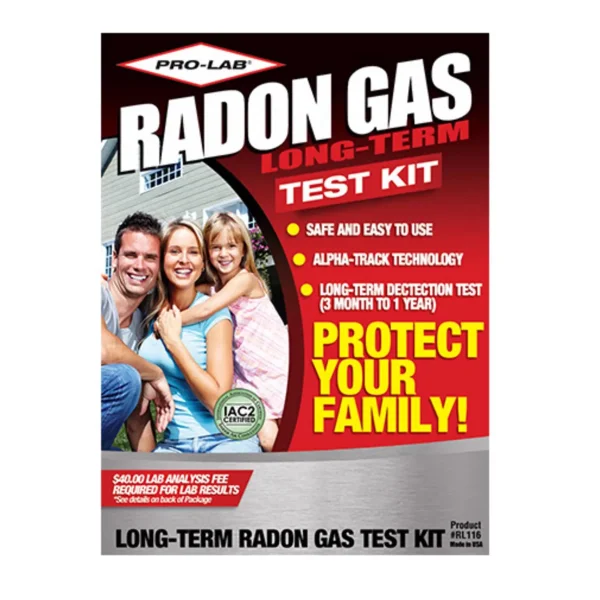
The Pro-Lab Radon Test Kit represents the gold standard for long-term residential radon measurement. Using alpha-track detection technology, it provides the same accuracy as professional inspectors use, at a fraction of the cost. This passive detector requires zero maintenance, no batteries, and includes full NRPP-certified laboratory analysis.
While it requires patience (3-12 months exposure), this method delivers the most accurate representation of your home's annual radon exposure. The EPA specifically recommends long-term alpha-track testing for permanent mitigation decisions, making this kit the preferred choice for serious homeowners.
Alpha-Track Technology Explained
How It Works
The Pro-Lab detector uses a small piece of special plastic (CR-39 or LR-115) that is chemically sensitive to alpha radiation:
- Passive Collection: Radon gas diffuses into the detector chamber through a filter
- Alpha Particle Tracks: Radon decay products emit alpha particles that strike the plastic
- Damage Creation: Each alpha particle creates microscopic damage tracks in the plastic
- Chemical Etching: Laboratory technicians chemically etch the plastic to enlarge tracks
- Optical Counting: Automated systems count tracks under microscopy
- Concentration Calculation: Track density correlates to radon concentration over exposure period
Why Alpha-Track Is the Gold Standard
Advantages over electronic monitors:
- True long-term average: Integrates radon levels over months, eliminating day-to-day fluctuations
- Immune to power outages: No batteries means uninterrupted measurement
- No calibration drift: Physical process is inherently stable
- Laboratory precision: Professional analysis ensures accuracy
- EPA recommended: Specifically endorsed for mitigation decisions
Limitations:
- No real-time feedback (complete blackbox until analysis)
- Requires minimum 90-day exposure (typically 3-12 months)
- Single-use only (cannot be reset or reused)
Accuracy and Precision
Laboratory Certification
Pro-Lab's laboratory holds:
- NRPP Certification (National Radon Proficiency Program)
- ISO 17025 Accreditation (international lab quality standard)
- EPA Approval (Environmental Protection Agency)
These certifications require:
- Blind sample testing (unknown concentration samples)
- Annual proficiency exams
- Quality control standards
- Measurement traceability to NIST standards
Real-World Accuracy
Precision at 4 pCi/L (EPA action level):
- ±25% at 90 days: Reading between 3.0-5.0 pCi/L
- ±20% at 180 days: Reading between 3.2-4.8 pCi/L
- ±15% at 365 days: Reading between 3.4-4.6 pCi/L
What this means: Longer exposure = better accuracy. A 6-month test is significantly more precise than 3-month minimum.
Comparison to Continuous Monitors
Study results (EPA testing):
- Alpha-track (90-day): ±20-25% variance
- Continuous monitor (7-day average): ±15-20% variance
- Continuous monitor (90-day average): ±10-15% variance
Key insight: While continuous monitors are more precise for short periods, alpha-track provides better representation of true annual exposure because it naturally averages seasonal variations.
Complete Instructions for Use
Package Contents
- 1× Alpha-track detector in sealed vapor barrier
- 1× Passive diffusion chamber (plastic housing)
- 1× Instruction card
- 1× Pre-addressed mailer envelope
- 1× Chain for hanging (optional)
- 1× Data form for lab submission
What's NOT included:
- Return postage (you pay to mail back to lab)
- Shipping envelope protection (recommend padded mailer)
Step-by-Step Deployment
Before Opening Package:
- Choose location: Lowest lived-in level (bedroom, family room, basement living area)
- Verify conditions:
- Closed-house conditions maintained for 12 hours before
- No major air movement (away from fans, HVAC vents)
- Not in kitchen, bathroom, or laundry room
- 20+ inches from walls
- 3-6 feet above floor
- Record start date: Write on instruction card
Deployment (5 minutes):
- Open sealed vapor barrier - do not open until ready to deploy
- Remove protective cover from detector chamber
- Place detector:
- On shelf or table (stable, won't be disturbed)
- Or hang from chain (bedroom dresser, bookshelf)
- Face-up orientation (filter opening upward)
- Record exact location on data form
- Record deployment date and time
- Do NOT cover or obstruct detector opening
During Exposure Period:
Maintain closed-house conditions as much as practical:
- Normal living is fine (this test measures real-world exposure)
- Avoid extended window-opening during test period
- Don't run whole-house fans continuously
- Normal HVAC operation is expected
- Short window opening (<1 hour/day) has minimal impact
Closed-house conditions NOT required for long-term tests - This is a key difference from short-term tests. The EPA does not require closed-house conditions for tests >90 days, since the test integrates seasonal variations. However, avoid extended periods of unusual ventilation.
Minimum Exposure Times by Use Case
| Use Case | Minimum | Recommended | Notes |
|---|---|---|---|
| Initial screening | 90 days | 180 days | Acceptable for first-time testing |
| Mitigation decision | 90 days | 365 days | EPA recommends full year if possible |
| Post-mitigation | 90 days | 180 days | Verify system effectiveness |
| Annual monitoring | 90 days | 365 days | Continuous year-round placement |
| Real estate | N/A | N/A | Not suitable - use 2-7 day charcoal test |
Seasonal Considerations:
Radon levels are typically:
- Winter: HIGHEST (closed windows, soil moisture, pressure differences)
- Spring/Fall: MODERATE
- Summer: LOWEST (open windows, different ventilation)
Implication: A 90-day winter-only test may overestimate annual average by 20-40%. A full 12-month test provides the most accurate annual exposure assessment.
Retrieval and Submission
After exposure period ends:
- Record retrieval date and time on data form
- Replace protective cover on detector chamber
- Complete data form:
- Homeowner name and address
- Detector placement location (room, floor level)
- Deployment and retrieval dates/times
- Total exposure days (calculated)
- Special conditions (if any)
- Package for shipping:
- Place detector in a non-plastic envelope or package
- Insert completed data form
- Use padded mailer envelope (not included)
- Affix proper postage
- Mail to Pro-Lab laboratory (pre-addressed envelope included)
Shipping tips:
- Use USPS First Class Mail (2-5 day delivery)
- Add tracking for peace of mind
- Do NOT delay shipping - send immediately after retrieval
- Avoid mailbox pickup in extreme heat (detector can be damaged)
Results Timeline
Typical turnaround:
- Laboratory receives detector: Day 0
- Etching and analysis: 3-5 days
- Results sent: 5-7 days from receipt
Results delivery:
- Standard: Mailed printed report
- Expedited: Email results available (check Pro-Lab website for option)
Results format:
- Radon concentration (pCi/L and Bq/m³)
- Exposure duration (days)
- EPA comparison (below/above 4 pCi/L action level)
- WHO comparison (below/above 2.7 pCi/L guideline)
- Recommendations (mitigation suggestions if elevated)
- Laboratory certification information
- QC data (measurement uncertainty)
Understanding Your Results
Results Interpretation
Concentration ranges:
| Result (pCi/L) | Result (Bq/m³) | Interpretation | Action |
|---|---|---|---|
| <2.0 | <74 | Low | No action needed - retest in 2-5 years |
| 2.0-2.6 | 74-96 | Below WHO | Consider mitigation, especially if <2.7 pCi/L goal |
| 2.7-3.9 | 100-144 | Moderate | EPA: Consider mitigation. WHO: Mitigate if practical |
| 4.0-9.9 | 148-366 | Elevated | EPA: Mitigate. WHO: Mitigate urgently |
| 10.0-19.9 | 370-737 | High | Mitigate within months - significant health risk |
| ≥20.0 | ≥740 | Very High | Mitigate urgently (weeks) - major health hazard |
Measurement Uncertainty
Your results will include uncertainty estimate, e.g.:
- Result: 4.2 pCi/L ± 1.0 pCi/L (95% confidence)
- Interpretation: True value is 95% likely between 3.2-5.2 pCi/L
Impact on decisions:
- 4.2 ± 1.0 pCi/L: Probably elevated, consider mitigation
- 3.5 ± 0.8 pCi/L: Borderline - might test again or mitigate to be safe
- 8.3 ± 1.5 pCi/L: Definitely elevated, mitigate regardless of uncertainty
Seasonal Adjustments
If you tested only winter (worst-case):
- Winter result × 0.7 = estimated annual average
- Example: 5.0 pCi/L winter → ~3.5 pCi/L annual estimate
If you tested only summer (best-case):
- Summer result × 1.4 = estimated annual average
- Example: 2.5 pCi/L summer → ~3.5 pCi/L annual estimate
Best practice: Test full 12 months to avoid seasonal adjustment uncertainty.
Comparison with Other Test Methods
vs. Short-Term Charcoal Test (2-7 days)
Pro-Lab Alpha-Track advantages:
- Much more accurate for annual exposure
- Less affected by short-term weather events
- Better represents true health risk
- EPA-recommended for mitigation decisions
Charcoal test advantages:
- Results in 1-2 weeks total (vs 3-12+ months)
- Better for real estate transactions
- Useful for quick screening
- Cheaper
When to use each:
- Charcoal: Initial screening, real estate, quick check
- Alpha-track: Mitigation decisions, annual monitoring, post-mitigation verification
vs. Continuous Electronic Monitor
Alpha-track advantages:
- More affordable
- No calibration drift over time
- Laboratory-certified accuracy
- No batteries or maintenance
- True seasonal integration
Electronic monitor advantages:
- Real-time feedback
- Trend analysis
- Can see impact of ventilation changes
- Reusable for ongoing monitoring
- Alerts when levels exceed thresholds
When to use each:
- Alpha-track: Annual baseline, confirmation testing, budget option
- Electronic: Ongoing monitoring, post-mitigation verification, air quality enthusiasts
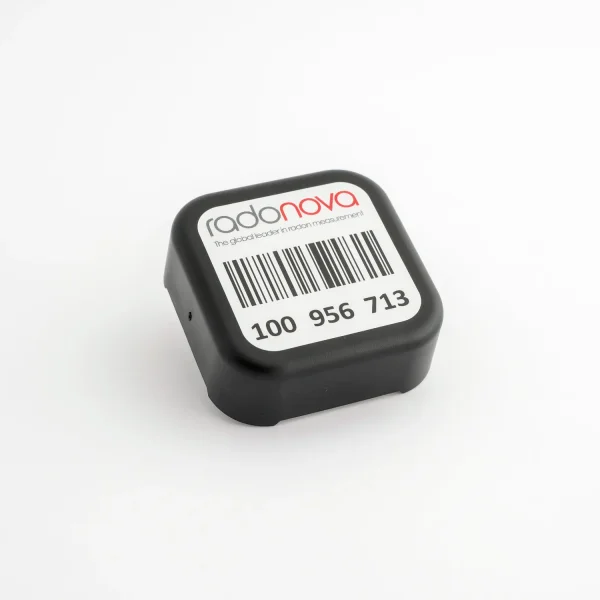
vs. Radonova Radtrak³
Both are alpha-track detectors with similar technology.
Pro-Lab advantages:
- Lower cost
- Widely available (Amazon, hardware stores)
- US-based lab (faster for US customers)
Radonova advantages:
- Shorter minimum exposure (90 days vs 91 days - negligible)
- Available in more countries (US, UK, EU)
- Optional digital results portal
- Slightly faster lab turnaround (3-5 days vs 5-7 days)
Recommendation: For US customers, Pro-Lab offers better value. For international customers, Radonova is the only option.
Real-World Use Cases
Use Case 1: Baseline Home Radon Assessment
Scenario: New homeowner wants to establish baseline radon level for long-term health planning.
Protocol:
- Deploy Pro-Lab detector in main bedroom (lowest lived-in level)
- Leave for full 12 months (one complete annual cycle)
- Retrieve and mail to lab
- Results guide mitigation decision
Outcome example:
- 12-month result: 3.2 pCi/L (±0.6 pCi/L)
- Interpretation: Near EPA action level, below WHO if on higher end
- Decision: Chose to mitigate to achieve <2 pCi/L goal
- Post-mitigation test: 1.1 pCi/L (90-day confirmation)
Why alpha-track was ideal:
- Most accurate annual exposure assessment
- Affordable for year-long test
- Laboratory certification provides confidence
Use Case 2: Post-Mitigation Verification
Scenario: Homeowner installed radon mitigation system and wants to verify long-term effectiveness.
Protocol:
- Wait 30 days after mitigation installation for system equilibration
- Deploy Pro-Lab detector in same location as original test
- Expose for 6 months minimum (180 days recommended)
- Compare result to pre-mitigation level
Outcome example:
- Pre-mitigation: 7.8 pCi/L (12-month test)
- Post-mitigation: 1.3 pCi/L (180-day test)
- Reduction: 83% reduction
- Success criteria: <4 pCi/L (EPA) or <2.7 pCi/L (WHO)
Why alpha-track was ideal:
- Verifies system works across seasons
- More rigorous than electronic spot-checks
- Laboratory certification documents success
- Affordable verification
Use Case 3: Annual Monitoring Program
Scenario: Health-conscious homeowner wants ongoing radon monitoring without investing in electronic device.
Protocol:
- Deploy new alpha-track detector every January 1
- Retrieve and mail every December 31
- Compare year-over-year trends
- Identify any emerging issues
Cost analysis:
- Savings: Minimal, but provides lab certification
Results tracking example:
- Year 1 (2022): 2.1 pCi/L - acceptable
- Year 2 (2023): 2.3 pCi/L - stable
- Year 3 (2024): 4.8 pCi/L - sudden increase!
- Investigation: Foundation crack discovered, sealed
- Year 4 (2025): 2.4 pCi/L - back to normal
Why alpha-track works:
- Annual snapshots sufficient for trend detection
- Laboratory precision ensures year-to-year comparability
- Affordable for multi-year monitoring
- No device maintenance or battery concerns
Limitations and Considerations
Not Suitable For
Real Estate Transactions:
- Inspection timelines (weeks) too short for 90+ day exposure
- Buyers want results before closing
- Use short-term test (2-4 days) instead
- Follow up with long-term if home purchase proceeds
Immediate Health Concerns:
- If symptoms suspected related to air quality, need faster results
- Use continuous electronic monitor for immediate feedback
- Alpha-track confirms after addressing urgent concerns
Troubleshooting Mitigation Systems:
- If mitigation system fails, need real-time monitoring
- Electronic monitor shows immediate system effectiveness
- Alpha-track only verifies long-term performance
Ongoing Research Projects:
- If studying radon variations, need continuous data
- Alpha-track provides single average, no trend data
- Electronic monitors capture hourly fluctuations
Common Mistakes to Avoid
Mistake 1: Insufficient exposure time
- Pulling detector at 60 days instead of minimum 90
- Result: Inaccurate and lab may reject analysis
- Solution: Set calendar reminder for retrieval date
Mistake 2: Disturbing detector during exposure
- Moving to different room mid-test
- Covering detector (blocks radon entry)
- Exposing to extreme heat (can damage plastic)
- Result: Invalidated test
- Solution: Choose location carefully and don't touch until retrieval
Mistake 3: Poor shipping practices
- Delaying shipment weeks after retrieval
- Shipping in non-padded envelope (damage risk)
- Insufficient postage (returned to sender)
- Result: Delayed or failed analysis
- Solution: Ship immediately in padded mailer with tracking
Mistake 4: Wrong placement
- Putting in bathroom (humidity interferes)
- Placing near window or vent (unrepresentative)
- Testing unoccupied basement (should test lived-in areas)
- Result: Non-representative measurement
- Solution: Follow EPA placement guidelines
Mistake 5: Misinterpreting seasonal tests
- Testing only winter, assuming result represents annual average
- Result: Overestimating annual exposure by 20-40%
- Solution: Test full 12 months or apply seasonal correction factor
Frequently Asked Questions
Q: Can I reuse the detector for a second test?
A: No. Alpha-track detectors are single-use only. The plastic film accumulates all alpha tracks during exposure and cannot be "reset." Each test requires a new detector kit.
Q: What if I accidentally move the detector mid-test?
A: If moved to different room/location, test is invalidated. If just repositioned in same room (e.g., shelf to table), test is still valid but note the change on the data form. Major changes in ventilation/conditions invalidate the test.
Q: How long can I store the unopened detector before deploying?
A: Unopened detectors in sealed vapor barrier are stable for 2-3 years. Check package for expiration date. Once opened, deploy immediately (don't leave open detector sitting for days before deployment).
Q: What if my house is under construction during the test?
A: Construction creates abnormal conditions (open doors/windows, dust, unusual ventilation). Results won't represent normal living conditions. Wait until construction complete and house has been lived-in normally for 1+ months before testing.
Q: Can I test multiple rooms simultaneously?
A: Yes. Purchase multiple kits and deploy in different locations. Common strategy:
- Kit 1: Main bedroom (lowest level)
- Kit 2: Family room (basement)
- Kit 3: Second bedroom (ground floor for comparison)
This provides room-to-room variation data.
Q: What if I lose the detector during the exposure period?
A: Contact Pro-Lab for replacement. If you find the original detector later, note on data form that exposure was interrupted and duration uncertain. Lab may still analyze but results will be qualified.
Q: Do I need closed-house conditions for long-term tests?
A: No. Unlike short-term tests (2-7 days), EPA does NOT require closed-house conditions for tests >90 days. Live normally. The test integrates seasonal variations naturally.
Q: Can I deploy during summer and get accurate results?
A: Yes, but results represent summer conditions, which are typically 30-50% lower than winter. For mitigation decisions, EPA recommends testing during typical living conditions, preferably including winter months.
Q: What if my result is exactly 4.0 pCi/L?
A: This is the EPA action level. Consider:
- Measurement uncertainty (e.g., 4.0 ± 1.0 means true value could be 3.0-5.0 pCi/L)
- WHO guideline is 2.7 pCi/L (lower)
- Mitigation typically reduces to <2 pCi/L
- Many choose to mitigate at borderline levels for peace of mind
Q: How quickly do results change after mitigation?
A: Mitigation systems reduce radon within hours to days. However, alpha-track detectors integrate over months, so you won't see immediate results. Wait 30 days post-mitigation, then deploy detector for 90-180 day confirmation test.
Q: Is this test suitable for commercial buildings?
A: Yes, same technology. However, commercial buildings may require multiple test locations per floor due to larger square footage. Consult EPA protocols for commercial radon testing.
Final Verdict
Who Should Buy the Pro-Lab Radon Test Kit
Ideal buyers:
- Homeowners establishing baseline radon levels
- Anyone making permanent mitigation decisions (EPA recommendation)
- Post-mitigation verification testing
- Budget-conscious annual monitoring programs
- Users preferring laboratory-certified results
- Those willing to wait 3-12 months for most accurate results
Better alternatives exist for:
- Real estate transactions needing quick results (use short-term charcoal)
- Ongoing monitoring and trend analysis (use continuous electronic monitor)
- Immediate feedback during mitigation (use electronic monitor)
- International customers outside US/Canada (use Radonova Radtrak³)
Overall Rating: 4.8/5
Strengths:
- Exceptional value
- Gold standard accuracy for long-term measurement
- Laboratory certification (NRPP, ISO 17025)
- EPA-recommended method for mitigation decisions
- Zero maintenance, no batteries
- Simple deployment and retrieval
Weaknesses:
- Very long wait time (3-12 months + 1 week lab)
- No real-time feedback or trend data
- Single-use only (not reusable)
- Return shipping cost not included
- US/Canada availability only
Bottom Line
It's the EPA-recommended method for permanent mitigation decisions, and for good reason: long-term alpha-track testing provides the most accurate representation of annual radon exposure.
The waiting period (3-12 months) is a feature, not a bug. Radon levels fluctuate dramatically day-to-day and season-to-season. A 12-month alpha-track test naturally integrates these variations, giving you the most reliable baseline for health risk assessment.
If you're serious about understanding your home's radon exposure and making informed mitigation decisions based on science rather than snapshots, this test kit is the obvious choice. The patience required is rewarded with confidence in your results and cost savings compared to repeated short-term testing.
For annual monitoring, post-mitigation verification, or establishing your home's radon baseline, the Pro-Lab Radon Test Kit is simply the best value in radon testing.
Last updated: October 30, 2026 Author: Radon Hub Editorial Team Research methodology: Pro-Lab official specs, EPA methodology verification, NRPP certification docs
Sources Cited
- Pro-Lab Radon Test Kit Official Page - Product specifications
- Pro-Lab FAQ - Testing protocols and lab details
- Amazon Pro-Lab RA100 - Pricing and customer reviews
- Ace Hardware Pro-Lab Kit - Availability
- Pro-Lab Radon Test Kit Review - Radon Guide - Independent analysis
- Hardware Store Radon Kits - Radon Test Canada - Comparison analysis
- Radon Testing Cost Guide - InspectandTest - Cost comparison
Related Products:
- Radonova Radtrak³ - International alternative for EU/UK customers
- Pro-Lab Charcoal Kit - Short-term option (2-7 days) for quick screening
- Airthings Wave Plus - Continuous monitor for real-time tracking