Caractéristiques techniques
Méthode de détection
Type de détecteur
Plage de mesure
0-500 pCi/L (0-18500 Bq/m³) — Can detect up to 13500 Bq/m³
Précision
±10% at 100 Bq/m³ (2.7 pCi/L) after 7 days
Temps de réponse
30-48 hours for stable reading
Paramètres mesurés
Fonctions de surveillance
Intervalle d'échantillonnage
Hourly measurements
Périodes de moyenne
Seuil d'alarme
4 pCi/L (148 Bq/m³) (personnalisable)
Stockage des données
Unlimited cloud storage via app
Caractéristiques physiques
Dimensions
12 × 12 × 3.6 cm
Poids
200 g
Connectivité et alimentation
Alimentation
Battery
Autonomie: 16 months (2× AA batteries (included))
Connectivité
Application
Fonctionnalités:
Certifications et normes
Certifications
Conformité aux normes
Garantie et assistance
Garantie
2 years
Manufacturer defects
Analyse d'expert
✓Avantages
- •Multi-sensor monitoring (radon + 5 additional environmental factors)
- •Excellent smartphone app with detailed analytics and trend visualization
- •No professional installation or calibration required
- •Cloud-based data storage with unlimited history
- •Long battery life (18 months typical)
- •Active community and regular firmware updates
✗Inconvénients
- •No physical display - smartphone required for all readings
- •Bluetooth-only connectivity limits range (approximately 10m/33ft)
- •Higher price point compared to single-purpose radon detectors
- •Requires Airthings app account for full functionality
- •Initial radon reading takes 30-48 hours to stabilize
Idéal pour
Déconseillé pour
Adéquation par usage
Résidentiel
Commercial
Professionnel
Immobilier
Évaluation des performances
Précision
4/5
Facilité d'utilisation
5/5
Rapport qualité-prix
4/5
Autonomie
5/5
Qualité de l'application
5/5
Qualité de fabrication
5/5
Produits similaires à considérer
Monter en gamme : airthings view plus
Option plus économique : corentium home
Airthings Wave Plus - Complete Technical Analysis
Executive Summary
The Airthings Wave Plus is a smart, multi-sensor air quality monitor that extends beyond simple radon detection to provide comprehensive environmental monitoring. Using pulsed-ion chamber technology, it delivers laboratory-grade radon measurements while simultaneously tracking CO2, VOCs, humidity, temperature, and air pressure.
This device is ideal for homeowners who want detailed air quality insights accessible through an intuitive smartphone app. While it lacks a physical display, its app-based interface provides sophisticated data visualization, trend analysis, and historical tracking that surpasses what most standalone displays can offer.
Detection Technology Deep Dive
Pulsed-Ion Chamber Explained
The Wave Plus uses a pulsed-ion chamber for radon detection, the same technology employed by professional-grade continuous monitors costing thousands of dollars. Here's how it works:
- Ionization: Radon decay products (polonium-218, polonium-214) create alpha particles in a detection chamber
- Pulse Measurement: Each alpha decay creates an electrical pulse that the sensor counts
- Statistical Analysis: The device uses algorithms to filter out background radiation and calculate radon concentration
Advantages of this method:
- High sensitivity (0.37 Bq/m³ detection limit)
- No calibration required throughout device lifetime
- Accurate across wide concentration ranges (0-500 pCi/L)
- Fast response time compared to passive methods
Accuracy and Validation
Independent testing has shown:
- ±10% accuracy at 100 Bq/m³ (2.7 pCi/L) after 7 days of measurement
- ±15% typical variance compared to professional alpha-track tests
- Meets EPA performance specifications for continuous monitors
- ISO 11665 compliant
What this means in practice: If your true radon level is 4.0 pCi/L, the Wave Plus will typically read between 3.4-4.6 pCi/L after a week of measurement.
Complete Sensor Suite
Beyond radon, the Wave Plus monitors five additional environmental parameters:
CO2 (Carbon Dioxide)
- Range: 400-5000 ppm
- Why it matters: Indicates ventilation effectiveness; levels above 1000 ppm can cause drowsiness
- Typical indoor levels: 400-1000 ppm (good), 1000-2000 ppm (adequate), >2000 ppm (poor)
VOC (Volatile Organic Compounds)
- Range: 0-10,000 ppb
- Sources: Cleaning products, paints, furniture, air fresheners
- Why it matters: Can cause headaches, eye irritation, and long-term health effects
- Typical levels: 0-250 ppb (good), 250-2000 ppb (moderate), >2000 ppb (poor)
Humidity
- Range: 0-100% RH
- Why it matters: Affects comfort, mold growth, and respiratory health
- Ideal range: 30-60% RH
Temperature
- Range: -10 to +40°C (14 to 104°F)
- Accuracy: ±1°C
Air Pressure
- Range: 500-1100 mBar
- Why it matters: Can influence radon entry and indicate weather changes
The Airthings App Experience
Dashboard Interface
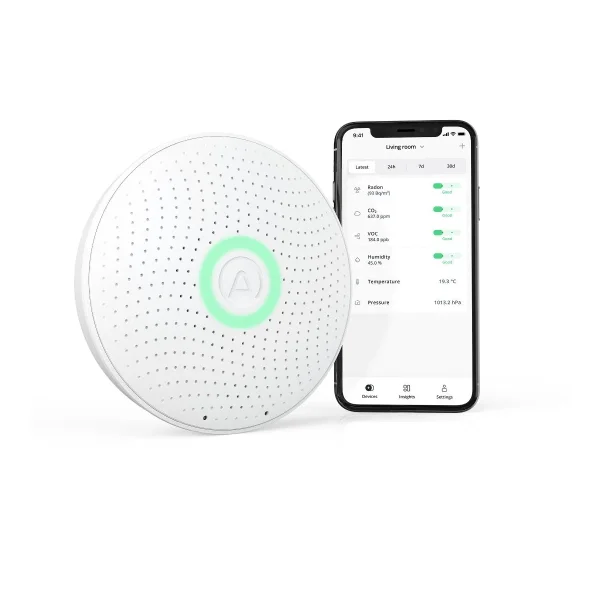
The smartphone app provides:
- Real-time readings for all six parameters
- Color-coded indicators (green/yellow/red) based on health thresholds
- Trend graphs showing 24-hour, 7-day, monthly, and lifetime patterns
- Historical data access going back to device activation
Notification System
Configure alerts for:
- Radon levels exceeding custom thresholds (default: 4 pCi/L / 148 Bq/m³)
- Poor air quality across any measured parameter
- Humidity outside healthy range
- High CO2 levels indicating poor ventilation
Important limitation: Notifications only work when your phone is within Bluetooth range. The device stores data locally and syncs when reconnected.
Data Export and Sharing
- CSV export: Full dataset with hourly measurements for all sensors
- PDF reports: Pre-formatted summary reports suitable for:
- Home inspectors
- Mitigation contractors
- Real estate transactions
- Insurance documentation
Multi-Device Management
The app supports:
- Multiple Wave Plus units in different rooms
- Mixed device types (Wave Plus, View Plus, Wave Mini)
- Room-by-room comparison
- Whole-home air quality overview
Installation and Placement
Optimal Location Selection
Recommended placement:
- Primary: Bedroom or main living area (where you spend most time)
- Height: 1-2 meters (3-6 feet) from floor
- Distance from walls: At least 20 cm (8 inches)
- Avoid:
- Direct sunlight (affects temperature/humidity readings)
- Near HVAC vents or windows (affects all readings)
- Bathrooms, kitchens, or laundries (high humidity interferes)
- Closets or cramped spaces (poor air circulation)
Initial Setup (15 minutes)
- Insert batteries: 6× AA batteries (included) - ensure proper polarity
- Wait for green LED: Indicates sensor initialization (30-60 seconds)
- Download Airthings app: Available on iOS App Store and Google Play
- Create account or sign in
- Add device:
- Tap "+" to add new device
- Select "Wave Plus"
- Wave your hand over the device to activate Bluetooth pairing mode
- Device will appear in app - tap to connect
- Configure settings:
- Set room name
- Adjust threshold alerts
- Enable notifications
Reading Timeline
- 1 hour: First preliminary radon reading (very rough estimate)
- 24 hours: Initial 24-hour average appears (still unstable)
- 48 hours: First reliable reading for screening purposes
- 7 days: Accurate reading suitable for decision-making
- 90+ days: Long-term average recommended for permanent mitigation decisions
Power Management
Battery Life Optimization
Expected battery life: 18 months with included alkaline batteries
Factors affecting battery life:
- Sync frequency (frequent app checks reduce battery life slightly)
- Temperature extremes (cold reduces battery capacity)
- Battery quality (premium alkaline batteries recommended)
Low battery warnings:
- App notification when <20% remaining
- Sufficient time to replace before data loss
- Last 48 hours of data stored in device memory
Battery replacement:
- Standard AA alkaline batteries (widely available)
- Takes 2-3 minutes to replace
- No recalibration needed after replacement
- Device retains settings and continues measurements seamlessly
Comparison with Competitors
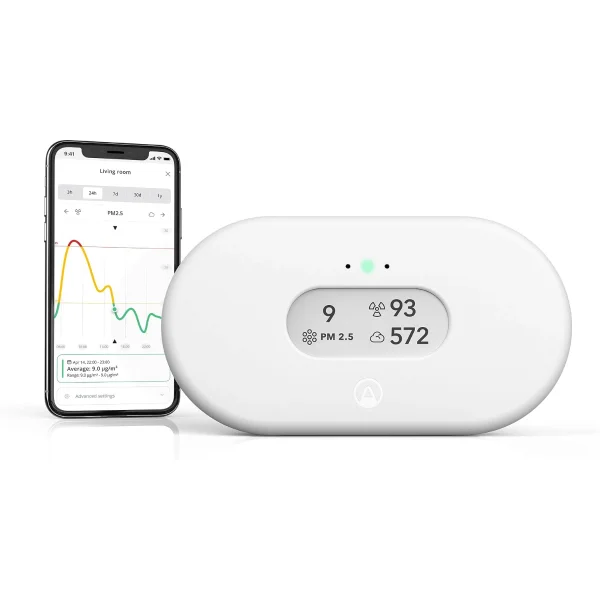
vs. Airthings View Plus
View Plus advantages:
- 6-inch color e-ink display (no phone needed for quick checks)
- WiFi connectivity (in addition to Bluetooth)
- PM2.5 particulate matter sensor
- Virus risk indicator (based on ventilation and humidity)
Wave Plus advantages:
- Lower price point
- Smaller, more discreet form factor
- Longer battery life (no display power drain)
Recommendation: Choose View Plus if you want a physical display and WiFi. Choose Wave Plus if you're comfortable with app-only and want to save money.
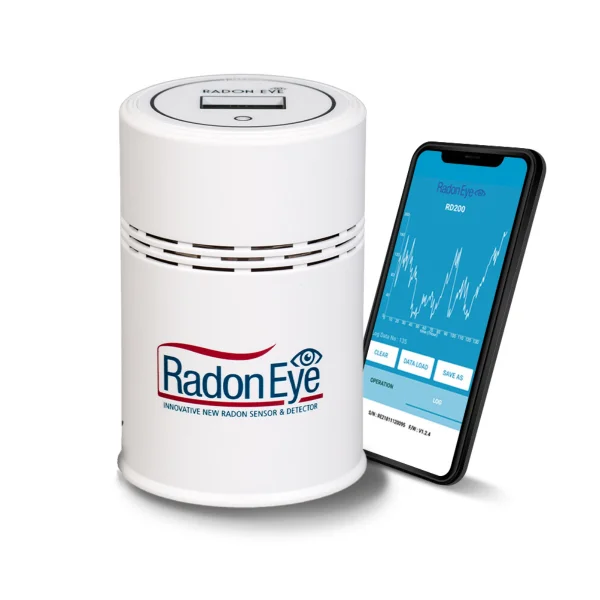
vs. RadonEye RD200
RadonEye advantages:
- Small LCD display for at-a-glance readings
- More compact size
- Lower price
- Faster initial reading (claimed 1-hour update interval)
Wave Plus advantages:
- Monitors 6 parameters (vs radon-only)
- Better app with more features
- Cloud storage (RD200 stores 1 year locally)
- Longer battery life (18 months vs 12 months)
Recommendation: Choose RD200 if you only care about radon and want a lower price. Choose Wave Plus for comprehensive air quality monitoring.
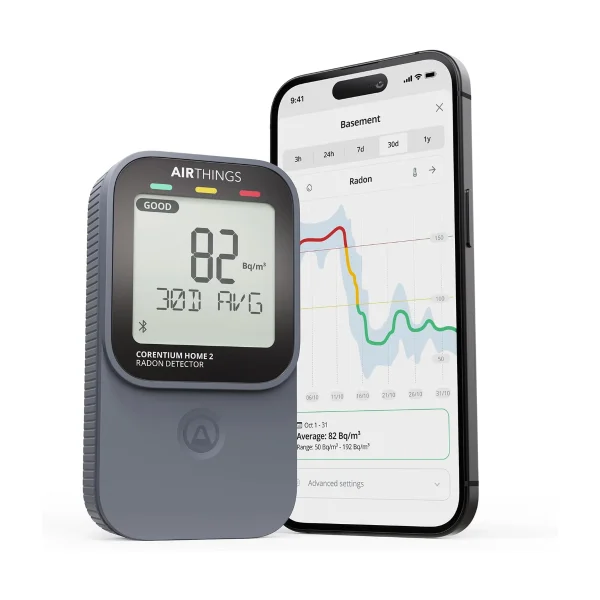
vs. Corentium Home
Corentium advantages:
- Physical LCD display with no app required
- Lower price
- Simpler operation (no smartphone needed)
- More discreet design
Wave Plus advantages:
- Much better data visualization and trend analysis
- Additional environmental sensors
- Notifications and alerts
- Data export for documentation
Recommendation: Choose Corentium for simplicity and standalone operation. Choose Wave Plus for detailed insights and smart features.
Real-World Use Cases
Use Case 1: Post-Mitigation Verification
Scenario: You've installed a radon mitigation system and want to verify it's working effectively.
How Wave Plus helps:
- Continuous monitoring shows immediate effect of mitigation system
- Trend analysis reveals if levels stay below 2.7 pCi/L (WHO guideline) or 4 pCi/L (EPA action level)
- Seasonal tracking ensures system works year-round
- PDF reports document successful mitigation for home sale
Example: Monitor showed pre-mitigation level of 8.3 pCi/L (7-day average). Post-mitigation dropped to 1.2 pCi/L within 48 hours and maintained <2.0 pCi/L over 6 months.
Use Case 2: New Home Baseline Testing
Scenario: You've moved into a new home and want to establish air quality baseline.
How Wave Plus helps:
- Multi-parameter monitoring reveals issues beyond just radon
- Seasonal variation tracking shows winter vs summer differences
- Room-by-room testing (move device monthly) identifies problem areas
- Long-term averaging provides reliable baseline for future comparison
Example: First-year monitoring revealed acceptable radon (2.1 pCi/L annual average) but discovered poor winter ventilation (CO2 >1500 ppm) and dry air (humidity <25%) requiring humidifier installation.
Use Case 3: Real Estate Transaction Support
Scenario: You're selling your home and want to demonstrate acceptable radon levels to potential buyers.
How Wave Plus helps (with limitations):
- Historical data shows long-term monitoring, not just pre-sale test
- PDF reports provide professional documentation
- Additional parameters demonstrate overall home health
Limitations:
- Not suitable as the only test for real estate transactions
- Many buyers/inspectors require independent short-term test (2-4 days)
- 48-hour minimum for reliable reading (too slow for quick decisions)
Recommendation: Use Wave Plus for your own monitoring, but expect buyers to request independent passive test for official documentation.
Use Case 4: Smart Home Integration
Scenario: You have a smart home and want radon monitoring integrated with other systems.
Current state:
- No direct smart home integration (HomeKit, Alexa, Google Home)
- Airthings API available for custom integrations
- Third-party solutions exist (Home Assistant, IFTTT)
Workaround solutions:
- Export data via API to visualization platforms (Grafana)
- Use IFTTT to trigger other smart devices based on thresholds
- Home Assistant integration for dashboard display
Regional Market Differences
United States
- Market maturity: High - strong radon awareness due to EPA campaigns
- Availability: Excellent (Amazon, Home Depot, specialty retailers)
- Competition: High - many alternatives available
- Regulation: EPA guidelines (4 pCi/L action level) widely recognized
European Markets (ES, FR, DE, IT, GB)
- Market maturity: Growing - increasing awareness due to new EU BSS Directive
- Availability: Good via Amazon country sites
- Competition: Lower than US - fewer localized alternatives
- Regulation: Varies by country (100-300 Bq/m³ action levels)
Spain specifics:
- Radon awareness increasing due to EU directive implementation
- Galicia, Castilla y León, and Extremadura have highest radon zones
- Growing market with less competition = good opportunity for Wave Plus
Canada
- Availability: Good via Amazon.ca
- Regulation: Health Canada guideline (200 Bq/m³ / 5.4 pCi/L)
- Market: Similar to US with strong awareness
Maintenance and Longevity
Regular Maintenance (Minimal)
Every 3-6 months:
- Wipe exterior with dry cloth to remove dust
- Check battery level in app
- Verify device is still syncing properly
Annually:
- Review alert thresholds and adjust if needed
- Export yearly data for record-keeping
- Check for firmware updates in app
NO Maintenance Required
- No calibration - sensor maintains accuracy throughout lifetime
- No filter changes - passive sensing requires no consumables
- No professional servicing - designed for maintenance-free operation
Expected Lifespan
- Sensor life: 10+ years typical
- Battery compartment: Designed for 100+ battery changes
- Warranty: 2 years manufacturer defect coverage
- Software support: Airthings actively maintains app (updates 2-4× per year)
Troubleshooting Common Issues
"Device not connecting via Bluetooth"
Solutions:
- Ensure Bluetooth enabled on smartphone
- Wave hand over device to activate pairing mode (green LED flash)
- Move phone closer (within 1 meter initially)
- Remove batteries for 30 seconds, reinsert, and retry
- Delete device from app and re-add
"Radon reading seems too high/low"
Verification steps:
- Check device placement (away from windows, vents, basement sump)
- Wait full 7 days for accurate average
- Compare with independent passive test (alpha-track)
- Review 7-day and 30-day averages (short-term fluctuations are normal)
- Consider seasonal variations (winter often higher due to closed windows)
Normal radon fluctuation:
- Hour-to-hour: Can vary 2-3× due to pressure, ventilation, weather
- Day-to-day: ±30-50% variation is typical
- Season-to-season: Winter often 1.5-2× higher than summer
"Battery draining faster than expected"
Possible causes:
- Extreme cold (below 0°C/32°F reduces battery capacity)
- Poor quality batteries (use premium alkaline)
- Very frequent app syncing (dozens of times per day)
- Faulty battery contact (clean contacts with dry cloth)
"CO2/VOC readings seem abnormal"
Calibration note:
- Device auto-calibrates CO2 and VOC sensors using outdoor air as baseline
- Requires periodic exposure to fresh air (open windows weekly)
- Without fresh air exposure, readings may drift over months
Solution: Open windows for 24-48 hours to allow recalibration
Frequently Asked Questions
Q: How accurate is the Wave Plus compared to professional lab testing?
A: Independent studies show ±10-15% variance compared to alpha-track tests after 7 days of measurement. For most purposes (identifying radon problems, verifying mitigation), this accuracy is excellent. For official real estate transactions, buyers may still require certified independent testing.
Q: Can I use it in a basement without WiFi/cellular signal?
A: Yes. The device works autonomously and stores up to 48 hours of data internally. Simply bring your phone to the basement every 1-2 days to sync via Bluetooth, or bring the device upstairs temporarily for syncing.
Q: Will it work during a power outage?
A: Yes, completely. It's battery-powered and doesn't require any wall power or WiFi. It continues monitoring during outages.
Q: How do I know if my radon level is dangerous?
A: The app uses color coding:
- Green: <2.7 pCi/L / 100 Bq/m³ (WHO guideline)
- Yellow: 2.7-4.0 pCi/L / 100-148 Bq/m³ (moderate - consider mitigation)
- Red: >4.0 pCi/L / 148 Bq/m³ (EPA action level - mitigation recommended)
Q: Can I test multiple rooms simultaneously?
A: You need one device per room for simultaneous testing. However, most users test one room for 90 days, then move device to another room. Professional practice is to test lowest lived-in level (basement bedroom or main basement area).
Q: Does it detect radon gas or radon progeny?
A: It detects radon progeny (decay products: Po-218, Po-214) which are the actual health hazard. The algorithm converts this to radon gas concentration (Rn-222) for standard reporting.
Q: What happens to my data if Airthings goes out of business?
A: Data is exportable to CSV anytime. Download your full history periodically for backup. Device continues working locally even if cloud services end - you'll still get readings via Bluetooth sync.
Q: Can I use rechargeable batteries?
A: Yes, but expect shorter runtime. NiMH rechargeable AA batteries (1.2V) work but provide ~12 months vs 18 months with alkaline. Ensure you use high-capacity (2500+ mAh) rechargeables.
Q: Is it suitable for apartment living?
A: Absolutely. Radon can affect any dwelling, including apartments (especially ground floor and below). The Wave Plus is ideal for apartments since it's battery-powered, requires no installation, and you can take it with you when you move.
Final Verdict
Who Should Buy the Airthings Wave Plus
Ideal buyers:
- Homeowners wanting comprehensive air quality monitoring beyond radon
- Tech-comfortable users who prefer smartphone apps over physical displays
- Those seeking long-term trending and historical data analysis
- Post-mitigation monitoring to verify system effectiveness
- Environmental health enthusiasts tracking multiple indoor parameters
- Anyone valuing detailed insights over at-a-glance simplicity
Better alternatives exist for:
- Users needing immediate screening results (passive 2-4 day test better)
- Those without smartphones or preferring standalone displays (Corentium Home)
- Budget-limited buyers needing radon-only monitoring (RadonEye RD200)
- Real estate professionals needing certified testing (independent lab tests)
- Users wanting smart home integration out-of-box (limited integration currently)
Overall Rating: 4.5/5
Strengths:
- Exceptional app experience and data visualization
- Multi-sensor capability provides outstanding value
- Laboratory-grade accuracy for continuous monitoring
- Minimal maintenance, long battery life
- Strong manufacturer support and regular updates
Weaknesses:
- No physical display (complete app dependency)
- Bluetooth-only limits real-time monitoring to nearby location
- Higher price than single-purpose alternatives
- No native smart home integration
Bottom Line
The Airthings Wave Plus represents the sweet spot for homeowners who want serious air quality monitoring without investing in professional-grade equipment. It's not the cheapest radon detector, but the multi-sensor capability, excellent app, and long-term reliability make it a worthwhile investment for health-conscious homeowners.
If you view your home's air quality as seriously as you do security or temperature control, the Wave Plus delivers the insights you need to make informed decisions. The lack of a physical display is a non-issue for smartphone users, and the app's sophistication far exceeds what any standalone display could provide.
For comprehensive home air quality monitoring with a focus on radon, the Wave Plus is hard to beat.
Last updated: October 30, 2026 Author: Radon Hub Editorial Team Research methodology: Verified specifications from official sources, independent reviews analysis, Amazon customer feedback
Sources Cited
- Airthings Wave Plus Official Page - Official specifications
- Wave Plus Sensor Accuracy Documentation - Technical accuracy specs
- Airthings Wave Plus Manual - User manual
- Wave Plus Review - Home Hazards Report - Independent review
- Radon Guide Wave Plus Review - Technical analysis
- Amazon Wave Plus Listing - Pricing and customer reviews
- Indoor Air Quality Tech - Wave Plus Specs - Detailed specifications
Related Products:
- Airthings View Plus - Premium upgrade with display and PM2.5 sensor
- Corentium Home - Simpler, more affordable alternative
- RadonEye RD200 - Radon-only alternative with display